

The Highlights - Vol. 21
The latest compilation of news, politics, & culture

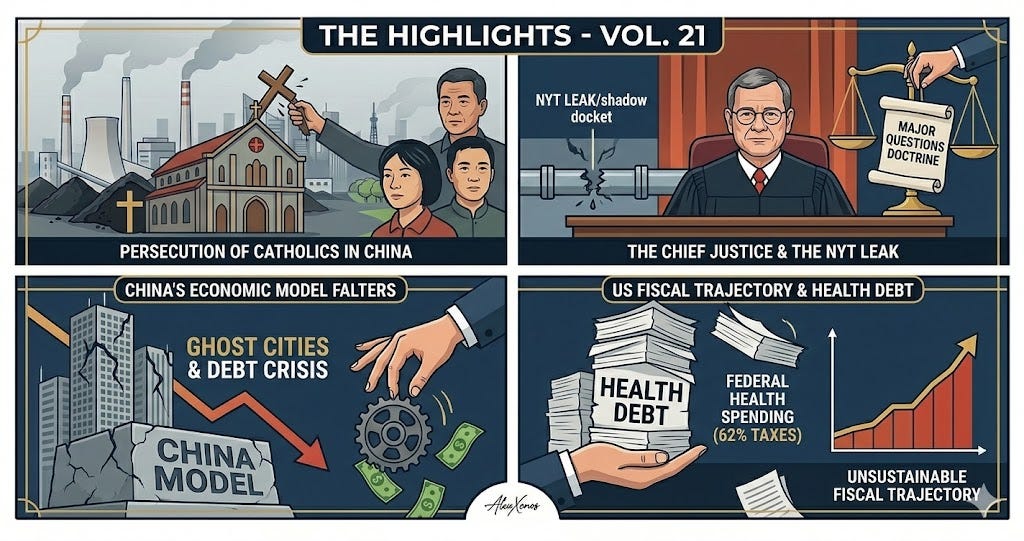
Disappearing, Torture, Detention: How the CCP Is Forcing Catholics to Join the State-Run Church
A new report from Human Rights Watch faults the Vatican for not doing more to help China’s Catholics.


Debt Digest by Cato
Federal health programs now consume 62 percent of relevant federal taxes. Brian Blase of the Paragon Health Institute writes on Tax Day: “Federal spending on health care programs consumed roughly 62 percent of all individual federal income taxes, corporate federal income taxes, and Medicare payroll tax revenue in 2025—up from 29 percent in 2000 and 17 percent in 1975.” The growth shows no sign of slowing, as “Medicare costs continue to escalate, as do costs in other programs—particularly Medicaid and Affordable Care Act subsidies.” This growth in health spending is driving large annual deficits and a rapidly growing national debt. Cato’s Adam Michel and Santiago Forster make similar conclusions on tax day, as “spending on interest and other mandatory programs (such as Social Security and health entitlements) will permanently surpass revenues next year.” They warn, “The current US fiscal trajectory is unsustainable. Eventually, taxes will need to rise, or spending will need to be cut. Large, European-style welfare states cannot be sustainably financed when a narrow sliver of income earners pay the lion’s share of taxes—big government requires high taxes on the middle class.”
The New York Times Surreptitiously Turns a Supreme Court Leak into an Inaccurate Hit Piece
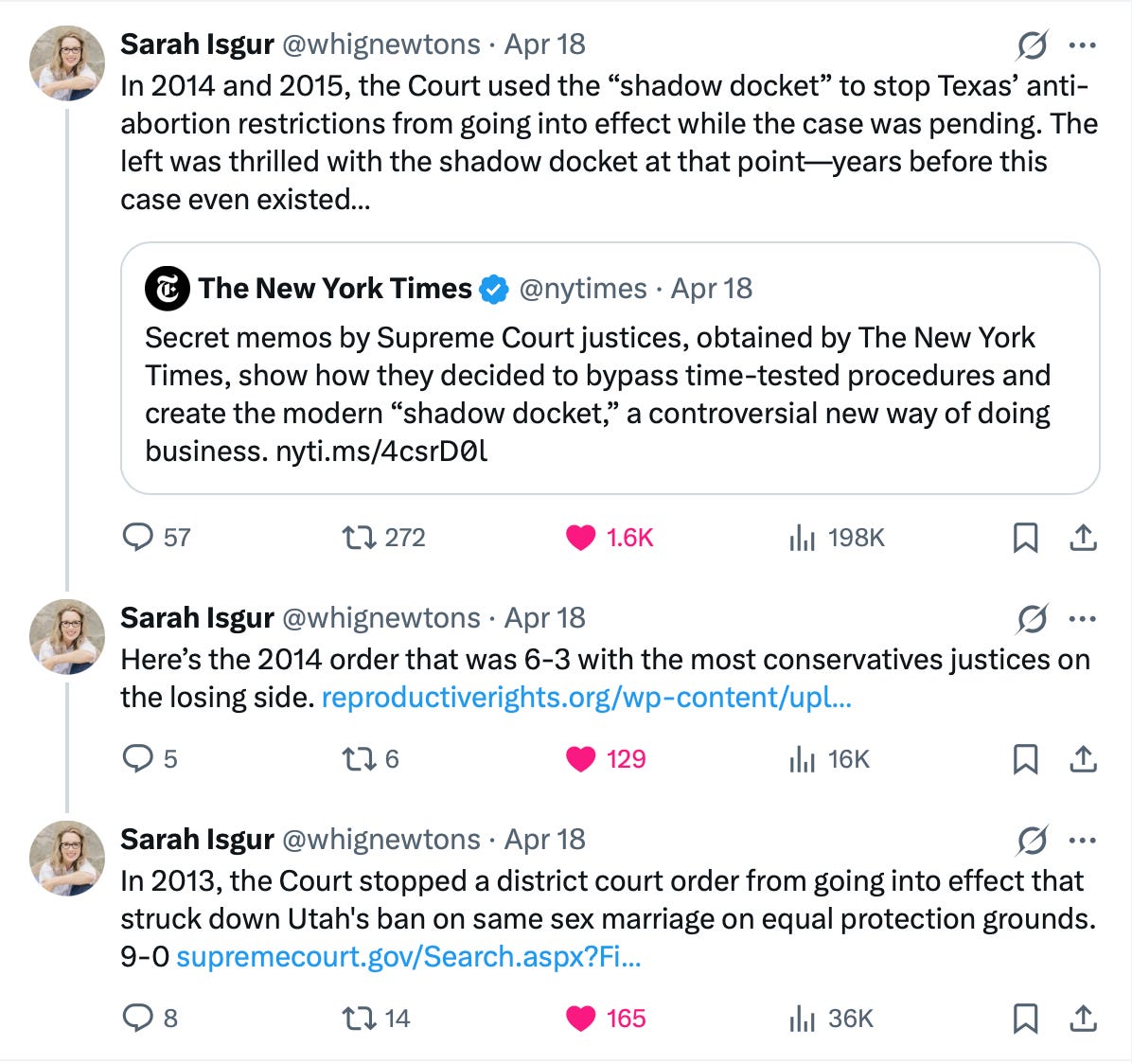
The NYT and the ‘Shadow Papers’ by Jack Goldsmith in Executive Functions
Goldsmith critiques a series of New York Times reports by Jodi Kantor and Adam Liptak regarding internal Supreme Court memoranda from 2016. These documents concern the Court’s interim order staying President Obama’s Clean Power Plan (CPP).
Goldsmith’s critique focuses on what he describes as “tendentious reporting” that frames the Court’s actions as unprincipled or personally motivated.
Key Critiques of the NYT Reporting
Subjective Characterizations: Goldsmith argues that the reporters attribute emotions like “angry” or “irritated” to Chief Justice Roberts without evidence in the documents. Goldsmith also disputes the claim that Roberts “bulldozed” other justices, noting that Justice Kennedy provided the deciding vote for his own independent reasons.
Selective Context on the “Shadow Docket”: The piece points out that the NYT failed to mention consequential rulings against Donald Trump on the shadow docket, such as those involving his Alien Enemies Act deportations and signature tariff policies.
Inconsistent Scrutiny: Goldsmith notes an imbalance in how law clerks were treated; the reporters provided biographical details for clerks assisting conservative justices but ignored the clerk who initialed Justice Breyer’s memo.
Misrepresentation of Legal Analysis: While the NYT suggested the use of the Major Questions Doctrine was outcome-driven to hurt Obama, Goldsmith highlights that Roberts recently used the same doctrine to strike down a major Trump administration policy.
The BBC Interview: Goldsmith defends the Chief Justice’s “unusual” step of quoting a BBC interview with the EPA administrator, noting that the interview was actually a central piece of evidence cited in the original application for the interim order.
The China Model Falters
The NR editorial board argues that China’s state-driven economic strategy has reached a structural dead end, contrasting its current struggles with the relative resilience of the American market model.
Key Economic Indicators
Misleading Growth: While recent figures show 5.3% GDP growth, the editors argue this is artificially propped up by state spending on infrastructure (like railroads) rather than organic demand.
Declining Relative Stature: In 2021, China’s economy was 78% the size of the U.S. economy; by 2024, that figure dropped to 64%.
Stagnant Private Sector: Household consumption, private investment, and global exports have all stalled or collapsed.
Structural Failures
The piece identifies several “internal” crises that suggest the slump is permanent rather than cyclical:
The Property Bubble: Trillions spent on “ghost cities” and vacant homes have led to a massive debt crisis for local governments and corporations.
Resurgent Leninism: The CCP’s increased control over industry has stifled the very entrepreneurial innovation that fueled China’s earlier rise.
Subsidized Failure: By ignoring market signals of profit and loss, the state has diverted resources into unproductive, government-mandated projects.
The “Beijing Consensus”
The editors conclude that the Beijing Consensus—the idea that authoritarian state-driven capitalism is a viable alternative to free markets—has been proven a failure. They warn American policymakers against adopting similar industrial statism, asserting that economic liberty remains the only superior model.


Michael Ramsey’s Originalist Defense of the Major Questions Doctrine (from 2024) - Gray Matters, The C. Boyden Gray Center for the Administrative State, at George Mason University’s Antonin Scalia Law School
Prof. Ramsey points to examples like the Charming Betsy canon and the presumption against retroactivity, arguing these show courts historically had authority to avoid broad readings of unclear statutes when doing so would risk serious harm. On that basis, he says modern courts may likewise use the Major Questions Doctrine to require Congress to speak clearly before delegating major policy decisions to agencies.
The discussion also explores whether substantive canons risk judicial overreach and how courts should approach ambiguity in statutes. Ramsey’s bottom line is that the doctrine is best understood as a form of judicial caution meant to reduce interpretive error in high-stakes cases.